This article originally appeared on VICE UK.
When Roxanne Parsons was six years old, her mom noticed that she would narrate her daily life. "She would fill in the silence, like, 'Look at that outside the window,' and, 'That's so great,'" explains Emma, Roxanne's mom. "It wasn't really until a bit later that I realized what she was doing—she was acting like she was on a YouTube channel."
Like many children, Roxanne has grown up with YouTube, and Emma says her daughter has only watched cable "a handful of times in her whole life." It's unsurprising that the schoolgirl, now ten, would like to be a YouTuber. "The thing I'm nervous about is putting her face out there," says Emma, who hasn't yet allowed Roxanne to create a channel. Thankfully, there is another option. For the last few months, Roxanne has been playing the simulation game Youtubers Life OMG!
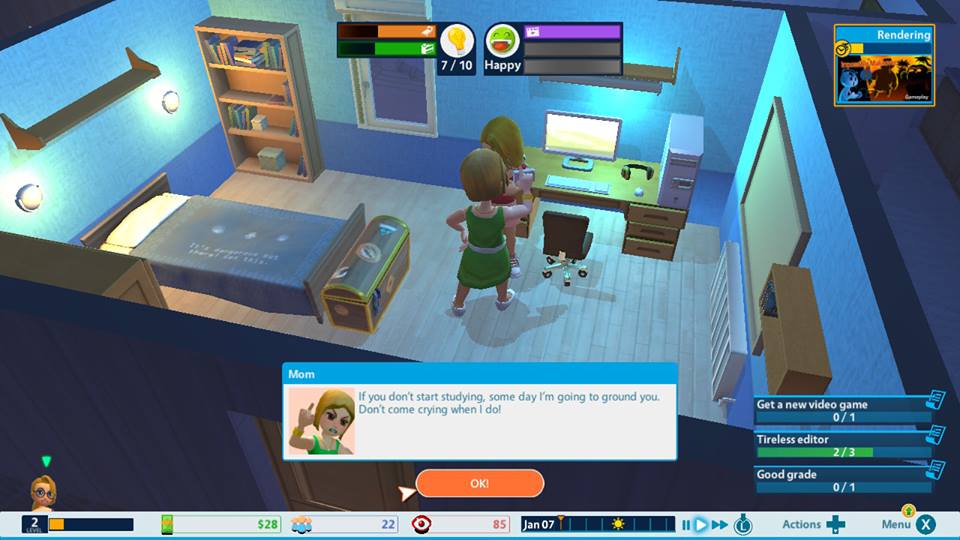
Released on Xbox One, PS4, and Nintendo Switch in November of 2018, Youtubers Life OMG! is the kind of thing people like to hold up as a sign of the impending apocalypse, clutching their "I don't want to live on this planet anymore!" memes like pearls. Yet despite the disparagement, the game—which is like The Sims, but instead of drowning your character in a pool, you try to make them into a famous vlogger—has sold over a million copies. Like it or not, Youtubers Life OMG! reveals a lot about modern life.
The game opens with a cut scene in which a successful YouTuber talks about how successful they are. "I manage my own network," is the third line the player reads in the game—naturally, the young audience knows exactly what this means. From there, you choose your character's appearance and select from six personality types, one of which is simply "Loaded." For a few years now, money has substituted for personality on YouTube. Videos titled "I spent $10,000 on…" thrive, while Jake Paul —the second highest earning YouTuber in 2018—has a song (that has been viewed 28 million times) featuring the lyrics "Gucci, Louis, Prada, it's a habit."
This—combined with the fact that many parents don't want to allow their kids to have a real YouTube channel—might explain the game's success. "They have asked, lots and lots and lots of times, if they can do YouTube videos—but I've never actually let them yet," says Theresa Ironmonger, mother of Nathaniel and Samuel. "I feel like they are too young—and too sensitive—to deal with the onslaught of general public nastiness that floats around the internet. I feel like it's my job to gate-keep until I think they can handle negativity in a safe way."
So is Youtubers Life OMG! really something we should disparage? Apart from a missing apostrophe, the game is mostly inoffensive. If anything, it suffers from being too realistic (I have 22 subscribers and have earned $3 in ad revenue). Dr. Elnaz Kashefpakdel, head of research at Education and Employers (the charity that undertook the study that found 6 percent of kids want to work in social media) says we have to start accepting that times are changing.
"Children in primary schools are the next generation of our employees and leaders—how can we ignore the fact that the internet and technology are going to be the building block of their career?" she says. "The conventional school-to-work transition is no longer the norm. Routes to the labor market are now very diverse and there is no right or wrong. Families and schools should be open about this and help broaden aspirations and instil the idea that anything is possible."
Gardner—who has three former pupils who went on to make a living as YouTubers—agrees, and says even part-time YouTubing can impress when it comes to getting apprenticeships. "If people have been making their own YouTube videos, that would go down very well because it shows initiative and it shows drive," he says.
After our chat, Roxanne's mom Emma decides it's time to let her daughter have a YouTube channel —provided she doesn't show her face. Instead, Roxanne wants to use the channel to showcase her homemade animations. "I wouldn't want, like, face-cam—it costs extra money and I don’t want to cost extra money. All I want to do is make videos," the ten-year-old says. "I'm very creative in general."
Which is all to say: The kids are alright, aren't they? Don’t forget to subscribe!
Sign up for our newsletter to get the best of VICE delivered to your inbox daily.
Follow Amelia Tait on Twitter.
from VICE http://bit.ly/2RtAEy1
Comments
Post a Comment