A few days back, I received an email with an entirely preposterous pitch: Panic, a developer mostly known for making specialized Mac software (they also funded Firewatch), was going to make a gaming handheld built around a “season” of games kept secret until they unlock on the device. That’s not even the wildest part: this handheld features a black-and-white (what) screen, a d-pad, two buttons, and a completely different way to interact with games: a crank.
A crank? A crank. Look at this thing:
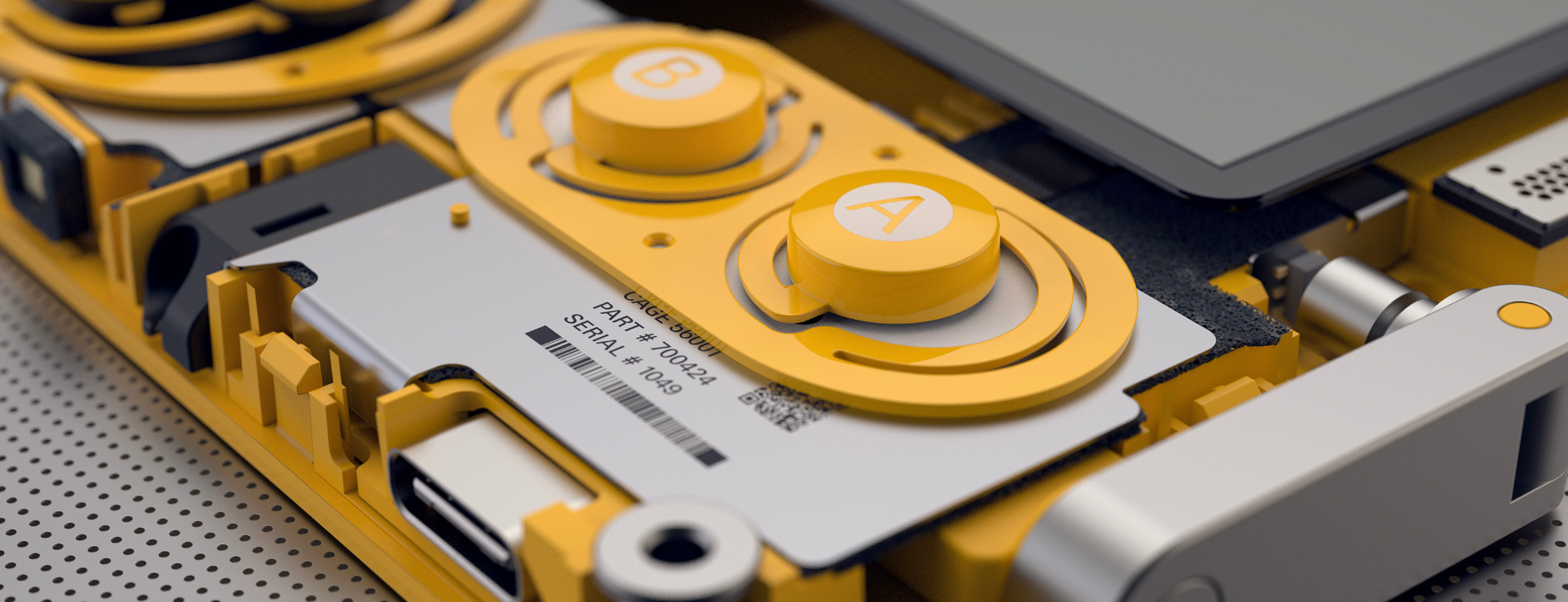
Playdate, coming early 2020, is the culmination of more than five years of experimenting at Panic. There’s no backlight on that black-and-white screen, but Panic claims that’s not a problem. It includes support for Wi-Fi and Bluetooth, there’s a spot to charge via USB-C, and a headphone jack. It costs $149, and you can’t pre-order it yet—that goes online later this year—but you’ll probably have to; Panic is saying the Playdate will have “limited stock.”
“This is a nightmare,” said Panic co-founder Cabel Sasser, when asked about the logistics of trying to figure out how many of these things to actually build. “I'm confident this goofy thing will find its audience, but, true to Panic form, we're not willing to bet the farm on it. We've got to be more careful than that so we can stick around for another 20 years or whatever.”
(Panic has been around since 1998, put on the map with their FTP software, Transit.)
For a time, it seemed entirely reasonable to expect that we'll never see another handheld gaming device ever again. Sony’s PSP and Vita devices were noble experiments that only proved how hard it was to emulate Nintendo’s success, and the hybrid Switch, where you can bring a full-fledged console anywhere and everywhere, seems like a point of no return. It's the best of both worlds.
Part of what Panic is betting on isn’t dissimilar to what Nintendo’s theory for the DS and 3DS, handhelds defined by attempts at change how we interact with games. The presence of two screens seems quaint in 2019, but it was genuinely baffling in 2004. Whereas Sony doubled down on “traditional” games and emphasizing raw power, Playdate has a crank, an idea sourced to Playdate’s design partner wanting to “break people out of their touch psychosis.”
The device specs are being kept under wraps, outside of being called "real beefy,” and here’s how Panic describes the black-and-white screen, which is likely to take some by surprise:
“Playdate’s 2.7-inch (68mm) screen is a unique, black-and-white, low-power LCD from Sharp, with a resolution of 400 × 240. On the surface, it might be tempting to compare the screen to, say, the Game Boy. But Playdate’s display is quite different: it has no grid lines, no blurring, is extremely sharp and clear, and has much higher resolution. It sounds odd to say, but: it’s truly a “premium” black-and-white screen.”
Key to the device is the season of games—12 in total—that arrive over the course of three months, one game per week. You don’t have to pay extra for them, but it seems like Panic will be keeping many under wraps; the pitch is making each a “surprise” when it unlocks.
One of those games is the game you saw above: Crankin’s Time Travel Adventure from Katamari Damacy designer Keita Takahashi. The crank is used to manipulate time forwards and backwards. Despite the presence of buttons, the only way to interact with Crankin’ is with said crank. Not all games will work that way, obviously, but it’s reasonable to expect many will make use of it.
There are other games coming from Bennett Foddy (Getting Over It), Zach Gage (SpellTower), and Shaun Inman (The Last Rocket), among others. What exactly they’re making for Playdate, however, remains unannounced, with more details later this year.
Developers will also have a chance to make games for it, too, and Panic’s suggested there will be more seasons for Playdate, should the device prove successful when it launches.
What a weird thing, right? Playdate won’t be at E3, so it’ll be a hot minute before we’re able to go hands on with what Panic is cooking up, but rest assured we’ll be keeping a close eye. It's almost too unbelievable not to.
Follow Patrick on Twitter. If you have any ideas for games that would play well with a crank, reach out at patrick.klepek@vice.com. He's also available privately on Signal.
Have thoughts? Swing by the Waypoint forums to share them!
from VICE http://bit.ly/2WiQtcp
Comments
Post a Comment