It’s Tuesday, January 21. In today’s newsletter: A “Potemkin trial,” a “rushed trial,” a “fair trial.” Plus: How the political “hobbyism” of the college-educated is ruining American politics.
*
« TODAY IN POLITICS »
(Jonathan Ernst / Reuters)
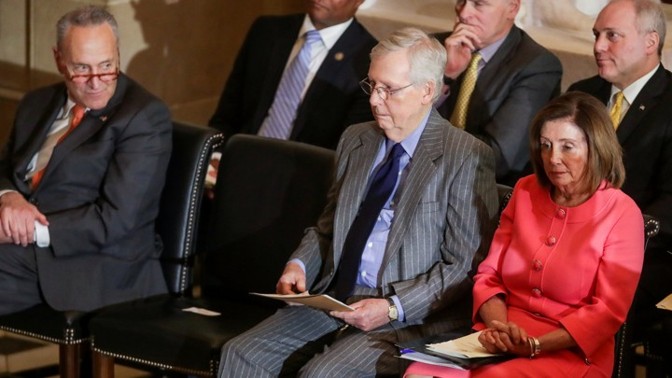
The Senate impeachment trial kicked off in earnest today. While (spoiler alert!) President Donald Trump almost certainly won’t be removed from office, and while all senators must follow no-speaking, no-cellphones rules during the trial, prepare for at least some histrionics.
The prosecution (the House impeachment managers) and defense (Trump’s legal team) are set to deliver their opening arguments this week, with the final vote to convict or acquit coming as early as next week.
Here’s a rundown of the characters worth keeping an eye on:
‣ Mitch McConnell: “Everyone’s going to hate the Senate impeachment trial of Donald Trump,” David Graham writes. But “the rules that McConnell has laid out … provide for a Potemkin trial, not a real one.”
‣ Pat Cipollone: The White House counsel will get his TV debut as he oversees Trump’s defense. Read the definitive profile of the lawyer Trump has always wanted.
‣ John Roberts: He’s constitutionally obligated to preside over the trial, but will the chief justice be an active participant, or more of a potted plant? “Roberts could ultimately be the last man standing in the GOP with the ability to say no to a president who barrels through law and custom,” Ron Brownstein writes.
‣ Adam Schiff: He’s one of seven House Democrats now prosecuting the case in the Senate. Impeachment has made Schiff a household name (okay, not everywhere). What does Schiff do now, after the spotlight of December’s House Intelligence Committee hearings?
+ Also an impeachment manager: Another familiar face, Jerry Nadler.
‣ The convincible ones: A couple of GOP senators have been virtually silent on impeachment. And these four occasional critics could ultimately turn against the president.
—Saahil Desai
*
« SNAPSHOT »
(Denis Balibouse / Reuters)
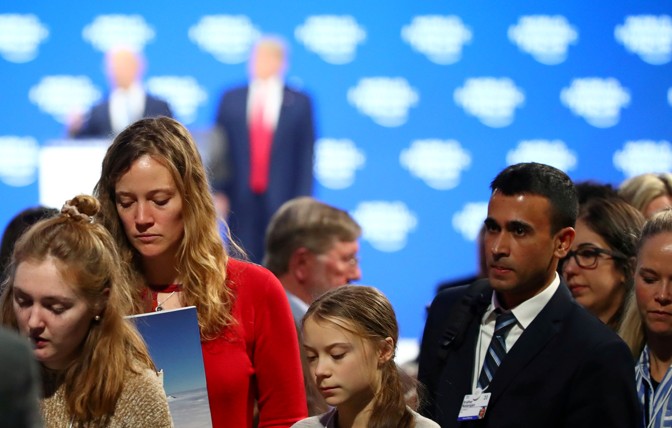
The climate change activist Greta Thunberg shortly before Trump’s speech at Davos today.
*
« IDEAS AND ARGUMENTS »
(STEVE HEAP / SHUTTERSTOCK / GETTY / THE ATLANTIC)
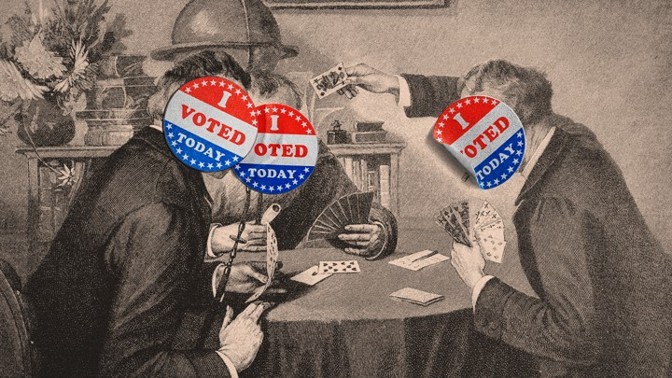
1. “They learn about and talk about big important things. Their style of politics is a parlor game in which they debate the issues on their abstract merits.”
College-educated white men dominate political discourse, but they live in a world of hypotheticals without actively participating in political movements or activism, something that the political science professor Eitan Hersh argues is destroying how politics in America is done.
2. “One group’s politics canceled those of others, in other words.”
The massive gun-rights protest that swarmed the Virginia capital on Martin Luther King Jr. Day was rife with contradiction. Chief among them: How gun-rights activists leveraged the Second Amendment to shut down “the free marketplace of ideas,” Garrett Epps writes. Guns aren’t just symbols.
3. “Whereas the president’s job is to supervise the White House staff and the executive-branch agencies that report to the White House, in the Trump presidency the inverse is what’s really happening ...”
Trump is smashing theories of modern presidential power, Susan Hennessey and Benjamin Wittes argue: If he can be easily manipulated, cajoled, or obstructed by his subordinates, what does that mean for future presidents and their agenda-setting power?
*
« EVENING READ »

(SHUTTERSTOCK / GETTY / PAUL SPELLA / THE ATLANTIC)
One of the most aggressive medical-debt collectors in the U.S. is the U.S. government itself.
Jared Bennett and Olga Khazan report on the nightmarish web of medical debt that some patients incur after treatment at a military hospital, in this collaboration with The Center for Public Integrity.
When Ricardo Gonzalez Jurado received his first bill from the Brooke Army Medical Center, he and the hospital agreed that he would pay $100 each month until the balance was settled. He sent in his $100 faithfully, according to his medical records. In 2014, BAMC asked for larger installments, and they compromised on $300. He began sending in that amount monthly. In 2017, Gonzalez Jurado received a letter from the hospital saying his balance had been “paid in full.” Knowing it hadn’t—he had only paid about $8,000 at that point—Gonzalez Jurado said he tried in vain to reach the hospital’s billing department. The hospital also began returning his $300 checks.
Gonzalez Jurado figured that, perhaps, he had satisfied the hospital’s desire for cash. Maybe it had realized he was old and not rich, he thought, and had given up on collecting. It was a gift horse; he decided to stop inspecting its teeth. That is, until April 2018, when he received a letter from the U.S. Department of the Treasury, which collects delinquent debt for government agencies, including the Department of Defense.
*
Today’s newsletter was written by Christian Paz, a Politics fellow. It was edited by Shan Wang, who oversees newsletters.
You can reply directly to this newsletter with questions or comments, or send a note to politicsdaily@theatlantic.com.
Your support makes our journalism possible. Subscribe here.

from The Atlantic https://ift.tt/37j0MzM
Comments
Post a Comment