Every weekday evening, our editors guide you through the biggest stories of the day, help you discover new ideas, and surprise you with moments of delight. Subscribe to get this delivered to your inbox.
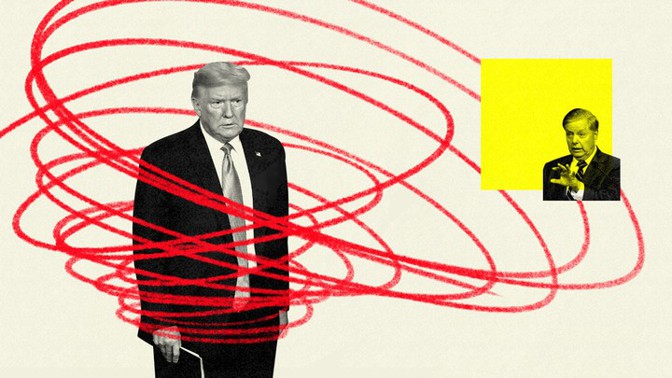
The president wants to reopen America by Easter, April 12. His allies aren’t so sure about that.
“The biggest political risk any president takes is deviating from sound advice,” Republican Senator Lindsey Graham told my colleague Peter Nicholas. “The economy can recover. Once a person is dead, that’s it.”
Inside the White House, the president’s preference is obvious, Peter reports: He wants people to get back to work quickly. This places him at odds with members of the medical community, state and local officials, and even some of his strongest Republican allies.
Trump is struggling to manage this crisis—one that plays to his worst instincts, as Peter first argued over a month ago and continues to observe. Here are four Trumpian tendencies, as noted by my colleagues, that muddy his effectiveness as a leader during this moment:
1. A distrust of science and experts
The president continues to mislead the public about the nature of this virus and, at times, minimize its potential to kill. We’ve created a compendium of his dishonesty, which we’ll continue to update in the coming days.
2. Turning everything into a culture war
(Or, the decision to refer to the coronavirus as the “Chinese virus”)
This maneuver is drawn straight from the Trump playbook, Adam Serwer argues, but this time, the stakes are enormously high.
“The point is to turn a pandemic that threatens both mass death and the collapse of the American economy into a culture-war argument in which the electorate can be polarized along partisan lines.”
3. Denying responsibility for mistakes
“I don’t take responsibility at all” was the president’s now-infamous reply when asked about the lack of testing kits. The quote summarized Trump’s presidency, James Fallows, who has contributed to The Atlantic for nearly five decades, argued.
4. Putting “America first”
Trump’s self-interested foreign policy isn’t helping, our contributing writer Kori Schake argues. His approach “strips away the goodness of America’s international engagement, leaving only the self-interest.”
A different perspective: Trump isn’t the only person who got this wrong, our contributing writer Zeynep Tufekci argues: “The reality-based, science-friendly communities and information sources many of us depend on also largely failed.”
What to read if … you just want practical advice about this outbreak:
One question, answered: Some readers wondered how worried they should be about continuing kids’ formal education while in quarantine.
If kids aren’t mentally stimulated during this time, the effects on their development will likely be visible when schools reopen, experts told our Family writer Ashley Fetters. Parents should act fast to keep kids engaged, the experts suggest, but there are tools for doing so outside the bounds of formal learning. Some examples from Ashley’s recent piece on the subject:
Michelle Martin, a professor at the University of Washington’s Information School and the founder of a summer literacy program for children, suggests sending kids who are learning math basics on a mission around the house or the building to count all the windows, for example—and then asking them the average number of windows in each room or apartment. Challenging children to pitch a tent—or, in the absence of a tent, create a play fort—out in the yard or at the park can teach kids innovation and resourcefulness.
Plus, some tips for parents juggling child care with working from home: Enlist kids’ help in everyday tasks that need to happen anyway, such as cooking, and try setting younger kids up with Play-Doh, art supplies, or recordings of their parents reading their favorite books.
What to read if … you’d like to read about something—anything—other than the coronavirus:
This 2017 feature on how the psychics who hear voices could be on to something
We are continuing our coverage of the coronavirus. View all of our stories related to the outbreak here. Let us know if you have specific questions about the virus—or if you have a personal experience you’d like to share with us. In particular, we’d like to hear about how the pandemic has affected your family life—whether that’s child care, partner relationships, or any other family dynamic.
This email was written by Caroline Mimbs Nyce, with help from Isabel Fattal, and edited by Shan Wang. Sign yourself up for The Daily here.

from The Atlantic https://ift.tt/33JH4vP
Comments
Post a Comment