It’s Monday, March 30. More states announced stay-at-home orders, and the White House extended its social distancing guidelines to until at least May.
In today’s newsletter: The social-distancing culture war. Plus: Take a tour of these drive-in movie theaters.
*
« TODAY IN POLITICS »

(Ina Jang)
Social distancing is a political act now.
There once was a time at the beginning of this pandemic when public health experts’ call for Americans to limit their public activity and practice rigorous social distancing hadn’t yet been swept up in the language of a culture war.
School closures came quickly across blue and red states, people of all parties quickly dispensed hand-washing advice, and “flatten the curve” seemed like a unifying rallying cry.
That rare slice of unpolarized American life is waning, my colleague McKay Coppins writes:
The consensus didn’t last long. President Trump, having apparently grown impatient with all the quarantines and lockdowns, began last week to call for a quick return to business as usual…[T]he comments set off a familiar sequence—a Democratic backlash, a pile-on in the press, and a rush in MAGA-world to defend the president. As the coronavirus now emerges as another front in the culture war, social distancing has come to be viewed in some quarters as a political act—a way to signal which side you’re on.”
Democratic strongholds—large metropolitan areas—felt the effects of the pandemic first. Now more people are dividing along familiar lines: by party, by geography, by religion, even by individual news outlet (McKay has already reported earlier this month on how the president’s news and social media allies have rallied to defend his distortions.)
Some politicians and pundits have even suggested that older Americans should be willing to risk death to jumpstart the economy. Others have painted the public health response as a move toward socialism and a sign of government overreach.
—Christian Paz
*
« SNAPSHOT »
(George Frey / Getty)
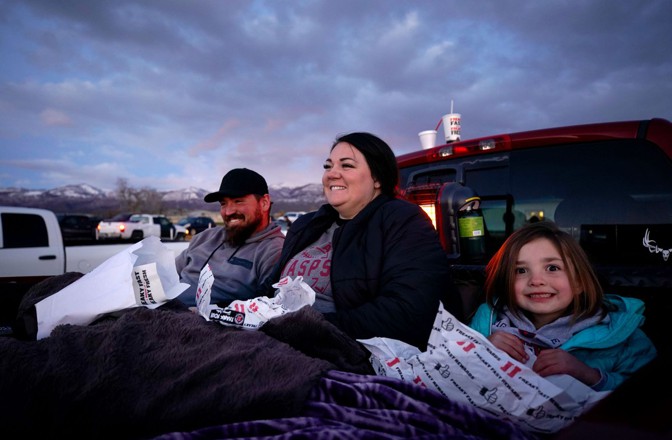
The Bills family gets comfortable in the back of their truck, with temperatures in the low 30s, before the movie Onward starts at the Basin Drive In in Mount Pleasant, Utah. The outdoor theater opened early this year, despite frigid temperatures, because the COVID-19 outbreak had closed indoor theaters.
See our photo editor Alan Taylor’s collection of other drive-in moments.
*
« THE CORONAVIRUS READER »
(Chloe Scheffe)
+ The threats of the coronavirus are already a lot for the living. They’re burdening those who work with the dead, too: Undertakers and funeral directors are struggling.
+ The U.S.’s community hospitals will soon face the onslaught of hospitalizations that urban hospitals face, and will have fewer resources with which to treat patients.
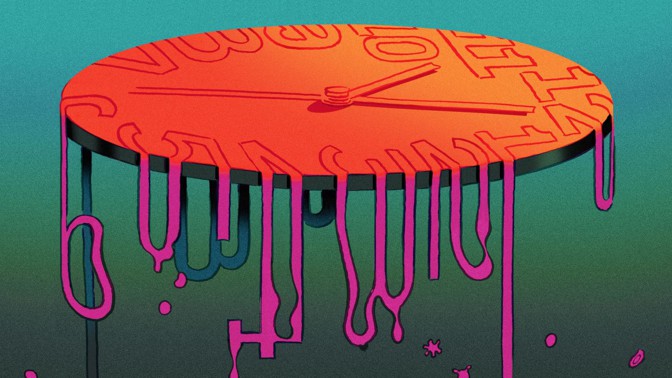
+ Social distancing, working from home, and general isolation all lend themselves to warping our understanding of time. Writers have been dealing that suspended state for ages. Here are some tips.
You can keep up with The Atlantic’s most crucial coronavirus coverage here.
*
Today’s newsletter was written by Christian Paz, a Politics fellow. It was edited by Shan Wang, who oversees newsletters.
You can reply directly to this newsletter with questions or comments, or send a note to politicsdaily@theatlantic.com.
Your support makes our journalism possible. Subscribe here.

from The Atlantic https://ift.tt/2JpsBvP
Comments
Post a Comment