Every weekday evening, our editors guide you through the biggest stories of the day, help you discover new ideas, and surprise you with moments of delight. Subscribe to get this delivered to your inbox.
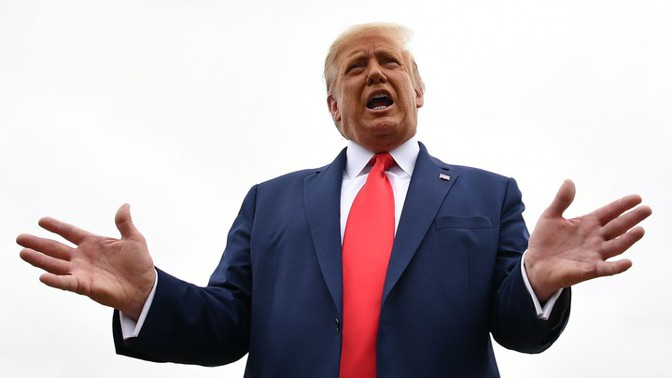
Last week, Jeffrey Goldberg, our editor in chief, reported that President Donald Trump had repeatedly disparaged members of the armed services, referring to fallen soldiers as “suckers” and “losers.”
Since then, details of his reporting have been confirmed by a number of other outlets. The White House, meanwhile, blasted out a string of furious denials, enlisting the president’s allies and even the first lady to defend him.
We caught up with Jeff to discuss his reporting —and what he’s thinking about as the election draws near.
The conversation that follows has been edited and condensed.
Caroline Mimbs Nyce: Has anything about the reaction to your story surprised you?
Jeffrey Goldberg: I wasn’t surprised by the insights that my sources had about the president. There are no real secrets here about Donald Trump’s attitudes.
I’m a bit surprised by the intensity of the reaction. And part of the intensity can be attributed to the outsized, overly defensive White House reaction. This is Donald Trump attacking a group of voters whom he’s counting on to return him to the White House—namely veterans and people who are active duty.
Caroline: One question we got via a reader is: Will this cost Trump votes?
Jeffrey: I would only note two things: One, the floor of his support has been fairly stable for years. And two, he did make the analytically acute observation that he could shoot someone on Fifth Avenue and his followers would still be with him.
Caroline: President Trump has challenged the integrity of your reporting. How do you respond to that?
Jeffrey: My sources are excellent. And if you don’t believe me, you can believe the many news organizations that have subsequently corroborated my story, including Fox News, notably.
Caroline: There’s also been some discussion around your use of unnamed sources. Can you talk a little bit about why you decided to grant anonymity here?
Jeffrey: It’s not a decision that should be made lightly. There are moral complications and ambiguities around granting anonymity to sources. But you have to balance those concerns with the public’s need to know, two months away from an election.
I would say this: This is what Donald Trump wants to talk about. Everybody uses anonymous sources. But often when people have no defense against information they find troubling, they attack the sources.
Caroline: This isn’t the first time you’ve covered the fraught relationship between this commander in chief and those who serve. Why are you so interested in that discord?
Jeffrey: Many presidents have had difficult relations with their generals, but we’ve never seen anything like this—in part because we’ve never seen a president of the United States talk about the military the way this person talks about the military.
I was really struck by Trump’s attack on John McCain in 2015 and by the inversion of political physics. After that attack, something changed in our country. Ordinarily, if a presidential candidate mocks a war hero, he has to leave the race. Instead, he won the presidency.
Caroline: What are your priorities for The Atlantic going into this election?
Jeffrey: Our journalists have done a fantastic job this year covering three crises simultaneously: the crisis in our democracy, the pandemic, and the racial reckoning. All of these things are interlinked, of course.
We’re going to continue to push hard on those subjects. The goal generally is to try to serve our readers—by giving them new information, useful analysis, and multiple viewpoints on very important subjects. And to level with them—to tell the truth.

One question, answered: What do young people have to fear from COVID-19?
“You might be used to thinking of 30-somethings as safe and seniors as at risk in this pandemic,” Derek Thompson writes in his latest. “But if a man in his 30s and a man in his 60s both contract COVID-19, it is more likely that the 30-something will develop a months-long illness than that the 60-something will die,” he warns, citing recent research.
Put more directly: “The most universal answer must begin with the observation that death is not a synonym for risk.”
Read.
Elizabeth Bradfield’s “Touchy” is a perfect poem for social distancing. It begins:
we say, when someone’s
sensitive. So touchy. So
dangerous and delicate and
ready to tip. Touching,
though, is sweet.
Watch.
Via our staff writer Hannah Giorgis: Give into the lush, neo-noir pleasures of the new Starz show P-Valley.
Dear Therapist

Every week, Lori Gottlieb answers questions from readers about their problems, big and small. In her most recent column, she advises a reader who feels responsible for her son’s death from a drug overdose:
I did my best to help our son have a rewarding life, as did his father, but the happy times were few, and his struggles were many and heartbreaking. Now I can’t stop replaying in my mind how he suffered and how I was unable to help him. I don’t know how to move forward.
Read the rest, and Lori’s response. Write to her anytime at dear.therapist@theatlantic.com.
Did someone forward you this newsletter? Sign up here.

from The Atlantic https://ift.tt/3bIU7Sf
Comments
Post a Comment